Why do some EVs charge slower than others is a question many drivers ask beside a public fast charger. Two cars may arrive with similar battery levels, yet one gains 100 miles while the other adds only 45. The difference is rarely caused by one problem. Battery chemistry, charging hardware, temperature, and software controls all shape the result.
An EV’s maximum charging rate is only a ceiling. The vehicle must accept that power, while the charger must deliver it. A car rated for 250 kW may briefly reach that figure, then reduce power as the battery fills. This protects the cells from excess heat and stress. State of charge matters. Charging from 10% to 50% is usually faster than charging from 70% to 90%.
Cold weather can make the difference visible. At 25°F, an unprepared battery may limit power until it warms. Preconditioning before arrival often improves charging speed. Cable ratings and shared charging cabinets can matter too. Some stations split power between two connected vehicles.
The advertised number is not the whole story. Real charging sessions vary. Drivers should check the vehicle manual, charger specifications, battery temperature, and recent software updates. Even then, estimates can be imperfect. That is worth remembering. This guide examines the main reasons behind slower EV charging and explains what drivers can realistically expect on the road.
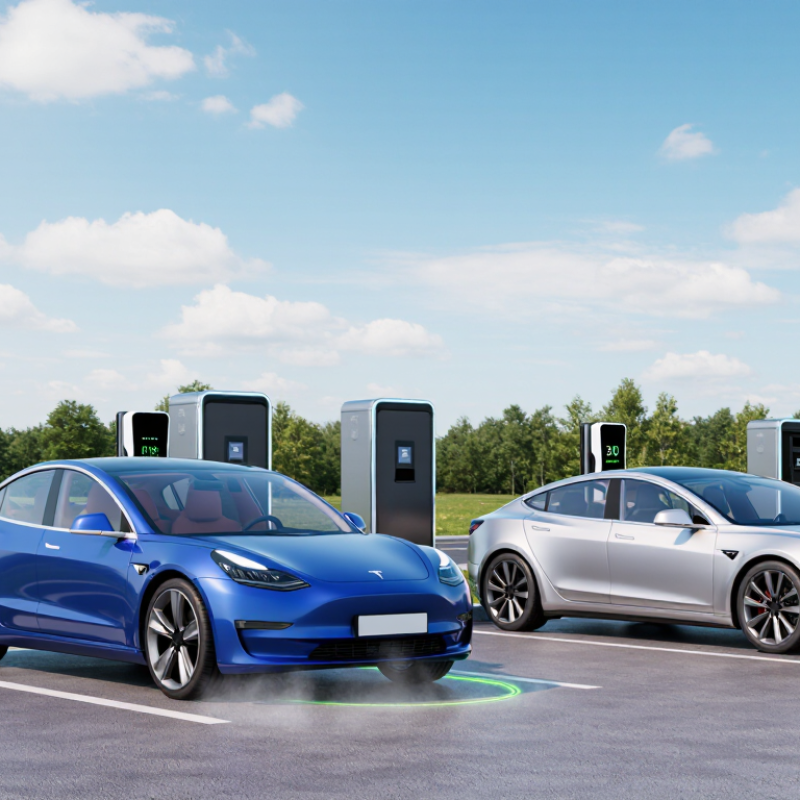
Top Reasons Why Some EVs Charge Slower Than Others
EV Charging Speed Basics: Power, Energy, and the kW–kWh Distinction
Charging speed becomes clearer when kW and kWh are separated. Kilowatts measure power, or how quickly electricity flows into the vehicle. Kilowatt-hours measure energy, or how much electricity the battery stores. A charger delivering 100 kW can add energy faster than one delivering 50 kW. However, the vehicle must also accept that power.
For example, adding 40 kWh at 80 kW may take about 30 minutes under ideal conditions. Real charging takes longer because some energy becomes heat. The vehicle may also reduce power as the battery approaches full. This gradual reduction is called charging taper. It protects the battery, but it surprises drivers watching the display.
The slowest part often controls the result. A vehicle may support 150 kW, while the charging station supplies only 100 kW. The reverse can happen too. An external charger may offer high power, but the vehicle’s onboard system limits AC charging. Cold batteries, high battery temperatures, low-voltage conditions, and long cables can reduce the rate further. State of charge matters greatly. Charging from 10% to 60% is usually quicker than charging from 80% to 100%. I once treated the charger’s advertised kW as a guaranteed speed, which was a poor assumption. Published figures are useful, but they describe conditions, not every parking-lot experience.
| Charging Scenario | Typical Rated Power | Approximate Energy Added in One Hour | Approximate Time to Add 42 kWh | What Usually Limits Charging Speed | Important Technical Notes |
|---|---|---|---|---|---|
| Standard household outlet | 1.4–1.9 kW | About 1.2–1.7 kWh | 22–30 hours | Low circuit capacity, household wiring, and the vehicle's portable charging equipment | This is AC charging. Actual power can vary by voltage, current setting, installation quality, and electrical safety limits. |
| Dedicated low-power AC circuit | 3.6 kW | About 3.2 kWh | 13–15 hours | Available circuit current and the vehicle's onboard AC charger | A dedicated circuit can provide more consistent charging than a shared household outlet, but it does not automatically make the vehicle charge faster than its onboard charger allows. |
| Common single-phase AC wall charger | 7.2–7.4 kW | About 6.5–6.7 kWh | 6.5–7 hours | Onboard AC charger rating, electrical supply, and installation limits | Many EVs accept approximately 7 kW on single-phase AC, while some vehicles are limited to a lower AC input even when the charging equipment is rated higher. |
| Higher-power three-phase AC charger | 11 kW | About 9.5–10 kWh | 4–4.5 hours | Whether the vehicle has an 11 kW three-phase onboard charger | The charging station may be capable of 11 kW, but a vehicle with a lower onboard AC limit will draw only that lower amount. |
| High-power three-phase AC charger | 22 kW | About 19–20 kWh | 2–2.25 hours | Vehicle onboard charger, site electrical capacity, and three-phase availability | A 22 kW AC station does not mean every EV will charge at 22 kW. Many vehicles are limited to approximately 7.4 or 11 kW on AC. |
| Moderate-power DC fast charger | 50 kW | Up to about 50 kWh before losses and power tapering | About 55–70 minutes | Vehicle DC acceptance limit, battery temperature, state of charge, and charger availability | DC charging bypasses the vehicle's onboard AC charger. Charging usually slows substantially as the battery approaches a high state of charge. |
| High-power DC fast charger | 100 kW | Up to about 100 kWh before losses and power tapering | About 30–40 minutes | Peak battery acceptance rate, battery cooling system, voltage range, and charging curve | A vehicle advertised with a lower maximum DC input cannot use the station's full 100 kW capability. |
| Very high-power DC fast charger | 150 kW | Up to about 150 kWh before losses and power tapering | About 25–35 minutes | Battery chemistry, cell design, thermal management, state of charge, and the vehicle's peak DC limit | Peak power is normally available only during part of a charging session. The average power over the session is usually lower. |
| Ultra-high-power DC fast charger | 250–350 kW | Up to about 250–350 kWh before losses and power tapering | About 18–30 minutes for compatible vehicles | Vehicle battery architecture, charging voltage, cable cooling, battery temperature, and station power sharing | The charger rating is not a guarantee of vehicle charging speed. Compatibility, battery condition, and the charging curve determine the real result. |
Calculation basis: Estimates assume adding 42 kWh to a battery, approximately equivalent to charging a 60 kWh usable battery from 10% to 80%. Charging losses, power sharing, temperature control, battery conditioning, and the normal reduction in power at higher state of charge can make real-world times longer. kW measures charging power, or the rate of energy transfer; kWh measures energy stored in the battery. A higher-kW charger can transfer energy faster, but the vehicle accepts only the maximum power allowed by its onboard charger, battery, software, and thermal system.
Kilowatts measure charging power, or how quickly electricity enters the vehicle. Kilowatt-hours measure stored energy. Think of kW as flow speed and kWh as tank volume.
The vehicle reduces power as the battery approaches full. This charging taper limits heat and protects battery health. The last few percentages often take surprisingly long.
No. The station, cable, battery, and software must support that level together. The slowest component controls the result. Advertised power is not guaranteed.
Not automatically. It can deliver more power with less current under suitable conditions. A compatible station and conversion hardware are still necessary. Simple on paper.
High current creates heat in cables and connectors. When temperatures rise, the system may reduce power. Thicker cables and cooling systems can support higher output.
Cold batteries usually accept power cautiously. Very hot batteries may also reduce charging speed. A warm battery often performs better, though conditions remain unpredictable.
No. Charging time from 10% to 80% is usually more useful. One vehicle may briefly reach high power, then taper sharply. Another may maintain a lower rate longer.
The local transformer or shared grid connection may have limited capacity. Multiple vehicles can divide available power. A sign may show high output, but the grid may disagree.
Arrive with a lower state of charge when practical. Warm the battery before fast charging. Check measured charging curves, not only maximum ratings. My assumptions may still be incomplete.
Why do some EVs charge slower than others? The answer depends on several connected factors, beginning with the difference between power and energy. Charging power, measured in kilowatts, determines how quickly electricity enters the vehicle, while battery capacity, measured in kilowatt-hours, affects how much energy the battery can store. AC charging commonly provides around 7.2–22 kW, whereas DC fast charging can range from 50 to 350 kW, depending on the vehicle and charging station.
Battery voltage and current limits also play a major role. An 800-volt system may accept high charging power more efficiently than a 400-volt system, but only when the vehicle and charger support it. Charging speed usually falls as the battery approaches 80% to protect battery health. Cold or excessively hot batteries may charge more slowly until preconditioning brings them to a suitable temperature. Finally, the cable, connector, onboard hardware, and available grid capacity can restrict charging power, even when a station advertises a higher maximum.

 Voltura Charger