China Top 10 Home EV Chargers How to Expand Your Setup?

Time:2026-10-08 Author:Ethan
0%

Expanding a home EV charging system sounds simple, but the right plan depends on your vehicles, parking space, and electrical capacity. China’s top 10 home EV chargers offer different power levels, connector options, apps, and load-management features. These differences matter when one charger becomes two, or when a future electric vehicle joins the driveway.

Tom Moloughney, an EV charging specialist and host of State of Charge, says, “The best home charging solution is the one that fits your daily routine.” That principle guides this discussion of How to expand your home charging setup. A homeowner might begin with a compact 7-kilowatt wall charger beside a garage door. Later, a second vehicle may require another charging point, a longer cable, or scheduled charging after midnight. The upgrade should support real driving habits, not impressive specifications alone.

Before adding equipment, check the breaker panel, cable route, charger compatibility, and local installation requirements. A qualified electrician can measure available capacity and identify whether dynamic load balancing is necessary. Smart chargers may reduce peak demand, but they cannot repair an undersized electrical system. This is where many expansion plans become too optimistic. More charging points do not always mean faster charging.

The comparison ahead examines practical expansion paths, including shared circuits, dual-port chargers, solar integration, and app-based control. It also considers installation space, weather protection, maintenance, and long-term flexibility. Small details matter. A cable crossing a walkway can become a daily nuisance. A poorly placed charger can make an otherwise excellent setup frustrating.
China Top 10 Home EV Chargers How to Expand Your Setup?

What Defines China’s Top 10 Home EV Chargers

China Top 10 Home EV Chargers: How to Expand Your Setup?

What defines China’s top 10 home EV chargers is not charging speed alone. The International Energy Agency reported that China represented about 60% of global electric car sales in 2023. This growth raises practical demands: stable power, safe installation, and clear energy data. A strong charger should support relevant GB/T requirements, IEC 61851 communication, and dependable residual-current protection.

For most homes, a 7 kW AC charger suits overnight charging. A 22 kW model sounds better, but it needs suitable three-phase supply and higher electrical capacity. Good systems offer dynamic load balancing, scheduled charging, solar compatibility, and remote fault alerts.

The China Electric Vehicle Charging Infrastructure Promotion Alliance reported more than 8 million charging facilities nationwide by the end of 2024, showing how quickly charging infrastructure is expanding.

Still, a “top 10” list can mislead. I would examine cable heat, connector durability, weather resistance, standby consumption, and service response before trusting a ranking. The charger should record charging history accurately, not merely display attractive numbers.

Independent safety testing and clear warranty terms matter more than a polished application. Expansion also needs spare circuit capacity, conduit space, and an electrician’s documented inspection. Small installation details decide long-term reliability.

How to Compare Charger Power, Compatibility, and Safety

Choosing among China’s top home EV chargers starts with power, not appearance. A 7 kW charger can add roughly 35–50 kilometers of range per hour, depending on the vehicle. An 11 kW model needs suitable three-phase wiring and a compatible onboard charger. More power is not always better. Your home’s service capacity, cable length, and daily driving distance matter more.

Compatibility requires careful checking. Match the charger’s connector with your vehicle, then confirm voltage, phase, and communication standards. Some cars accept high charging power but limit it internally. A practical check includes the parking location, cable reach, wall strength, and weather exposure. A charger rated for outdoor use should still have sealed connections and reliable temperature monitoring. Small details can prevent frustrating charging interruptions.

Tips: Ask a qualified electrician to assess the circuit before installation. Look for overload protection, residual-current protection, and clear fault indicators. Check whether load management can reduce charging when household appliances run together. Keep the cable away from standing water and vehicle wheels. Do not assume a higher rating guarantees faster charging. That assumption is easy to make, and often wrong. Reviewing the installation manual and local electrical requirements adds another layer of reliability.

China Top 10 Home EV Chargers: How to Expand Your Setup?

Comparison of nominal AC charging power, vehicle compatibility, and estimated charging time for a 60 kWh battery.

Power comparison

Single-phase setups range from approximately 3.5 kW to 11 kW. Three-phase setups provide about 10.5 kW to 21.1 kW when supplied at 380 V.

Compatibility

Actual charging speed is limited by the vehicle’s onboard AC charger. Common home interfaces include GB/T AC and Type 2 AC, depending on the vehicle and installation.

Safety essentials

Use a dedicated circuit with correctly sized overcurrent protection, protective earthing, residual-current protection, suitable cable sizing, and installation by a qualified electrician.

Estimated charging time assumes a 60 kWh battery and 90% overall charging efficiency. Nominal power is calculated from common 220 V single-phase or 380 V three-phase supply values; real-world results vary by vehicle limits, grid conditions, temperature, and battery state of charge.

How to Plan Your Home Electrical Capacity

Planning a home EV charger starts with the electrical service, not the charger price. In practice, a 7 kW unit can draw about 32 amps at 220 volts continuously. An 11 kW unit may need roughly 48 amps. Your main breaker, wiring, and meter must handle that demand safely. Ask a licensed electrician to inspect the panel and complete a formal load calculation. Guesswork is risky.

Many homes have 60- or 100-amp service, while newer properties may have 200 amps. The number alone does not prove spare capacity. An electrician should consider heating, cooking, water heating, solar equipment, and future appliances.

A dedicated circuit is normally required, with correct cable size, overcurrent protection, grounding, and residual-current protection where local rules require it. Keep the cable route short when possible. Long runs can increase voltage drop and installation cost.

Smart charging can reduce peak demand by charging overnight or limiting current during busy periods. It may help, but it does not repair undersized wiring. Leave room for a second vehicle if expansion matters.

I once saw a plan focus on charging speed while ignoring a crowded panel. That was an expensive lesson. Recheck capacity after renovations, and obtain the required inspection before regular use. Local standards differ.

How to Expand from One Charger to Multiple Charging Points

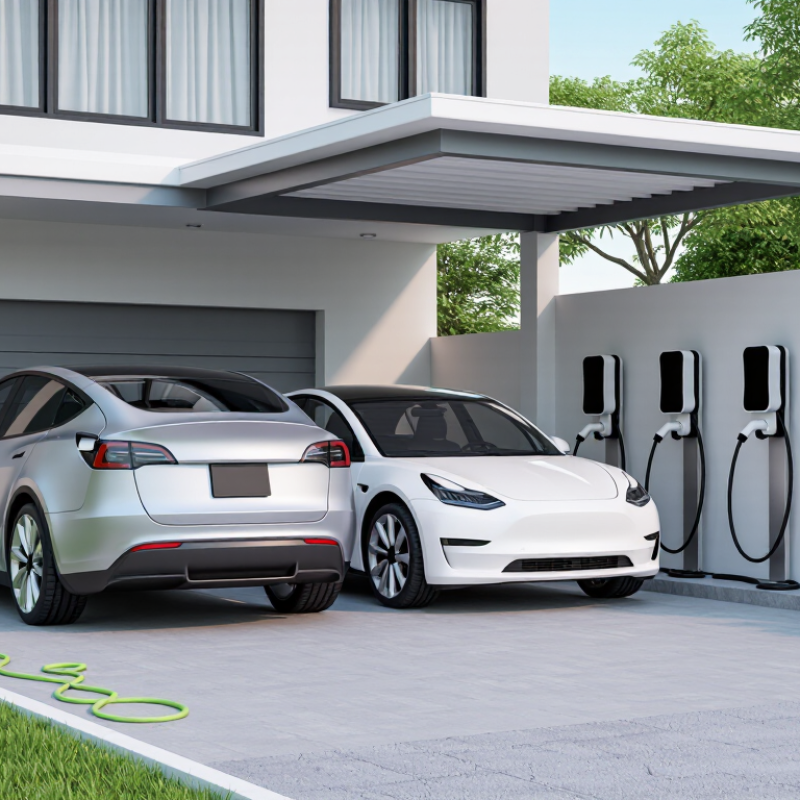
Expanding from one home EV charger to multiple charging points requires more than adding wall units. In practice, the household’s electrical capacity becomes the real starting point. Review the service rating, breaker panel, cable routes, and the parking layout with a qualified electrician. A second charger may need a dedicated circuit, while two high-power units could overload the supply during evening use.

Smart load management can share available power between vehicles. For example, one car might charge at 7 kW while another receives the remaining capacity. When the first vehicle finishes, charging can shift automatically. This approach reduces peak demand and may avoid an expensive service upgrade. However, it depends on compatible equipment and stable communication. Keep a manual charging option available.

Plan the installation around daily habits. Place each charging point near its parking space, protect outdoor sockets from rain, and avoid cables crossing walking paths. Label each circuit clearly inside the panel. Leave space for future maintenance. I once saw a neat installation become inconvenient because the cable was too short for the second parking bay. Small details matter. Local electrical rules, inspection requirements, and residual-current protection must also be checked before use. The safest setup is not always the fastest or cheapest, and that trade-off deserves an honest review.

China Top 10 Home EV Chargers: How to Expand Your Setup?

How to Expand from One Charger to Multiple Charging Points

Stage Home Charging Configuration Typical Number of Points Typical Output per Point Approximate Total Connected Load Recommended Electrical Arrangement Best Application Key Expansion Consideration
1 Single Basic Charger 1 3.6–7.4 kW AC 3.6–7.4 kW One dedicated circuit with suitable overcurrent protection and residual-current protection One electric vehicle in a private garage Reserve space in the distribution board for future circuits
2 Single High-Power Charger 1 11–22 kW AC 11–22 kW Dedicated higher-capacity circuit; three-phase supply may be required for the upper range Daily charging with short parking windows Confirm vehicle acceptance, utility capacity, cable size, and local installation rules
3 Two Independent Chargers 2 3.6–7.4 kW each 7.2–14.8 kW Separate circuits with coordinated protection and clear circuit labeling Two vehicles charged overnight Check whether both vehicles may charge simultaneously at full output
4 Two Chargers with Load Sharing 2 Up to 7.4 kW each Usually limited to the available site capacity Dynamic load management distributes current between the two charging points Homes with limited electrical service capacity Load monitoring equipment and compatible communication functions are needed
5 Three-Point Residential Setup 3 3.6–7.4 kW each 10.8–22.2 kW before load control Multiple dedicated circuits connected through a planned sub-distribution board Large households or properties with several EVs Use scheduled charging or dynamic balancing to avoid service overload
6 Shared Garage Charging Group 4 3.6–11 kW each 14.4–44 kW before load control Central protection, individual branch circuits, and clearly identified parking bays Small residential buildings or shared private garages Plan cable routes, access control, billing allocation, and maintenance access
7 Solar-Assisted Multi-Point Setup 2–4 3.6–11 kW each Managed according to solar generation and grid capacity Energy management system coordinates chargers, solar generation, and optional battery storage Homes seeking greater use of on-site renewable energy Solar output varies by season and weather, so grid backup remains important
8 Charger-and-Battery System 2–4 3.6–11 kW each Peak grid demand can be reduced through battery support Energy management system prioritizes household loads, battery charging, and EV charging Properties with demand limits or time-of-use electricity pricing Battery capacity, inverter rating, backup strategy, and ventilation must be evaluated
9 Managed Apartment or Workplace Cluster 5–8 3.6–11 kW each 18–88 kW before load control Networked chargers with centralized monitoring and an overall site power limit Multi-unit housing, offices, and private employee parking Define user permissions, charging schedules, usage records, and fault-response procedures
10 Scalable Multi-Point Charging Hub 8 or more 3.6–22 kW AC per point Determined by transformer, service entrance, and dynamic power allocation Dedicated charging distribution system with centralized energy management and expansion-ready cable routes Residential compounds, fleet parking, and mixed-use properties Complete a load study before installation and leave capacity for future chargers
Planning note: Actual charging capacity depends on the vehicle’s onboard charger, local supply voltage, available service capacity, cable length, protection devices, installation conditions, and local electrical regulations. A qualified electrician should verify the design before adding multiple charging points.

How to Install, Manage, and Future-Proof Your EV Charging Setup

Choosing among China’s top ten home EV chargers should begin with your daily driving pattern, not a popularity list. Check charging power, connector compatibility, weather protection, and local electrical capacity. A 7 kW unit often suits overnight charging, while higher output may require a stronger circuit and professional assessment. Measure the cable distance before installation. Small details matter.

Install the charger on a solid wall, away from standing water and vehicle impact zones. A licensed electrician should verify grounding, circuit protection, and cable sizing. Do not rely on a household socket without inspection. I once underestimated cable length by two meters; the final routing looked untidy and created unnecessary tension. Leave enough clearance for maintenance and future vehicle changes.

For management, use scheduling features to charge during lower-demand periods, if available. Review energy records monthly and inspect plugs, cables, and indicator lights. A simple log can reveal overheating or unusual charging delays early.

Choose equipment with firmware updates, open communication standards, and load-balancing support. These features can help when adding solar power, a second charger, or another electric vehicle.

Future-proofing is not about buying the most powerful unit today. It is about leaving safe capacity, flexible wiring, and room to revise the plan. Be realistic. Your household’s needs may change faster than expected.

FAQS

Is charging speed the main measure of a good home EV charger?

No. Stable power, safe installation, accurate energy records, and fault protection matter too. Fast is not always better.

What charging power suits most homes?

A 7 kW AC charger usually supports overnight charging. A 22 kW unit needs suitable three-phase power and greater electrical capacity.

Which safety features should a home charger include?

Look for residual-current protection, reliable communication, weather resistance, and durable connectors. Independent safety testing is valuable.

Can solar power work with a home EV charger?

Yes, if the system supports solar compatibility and suitable energy control. Check how it handles cloudy periods and changing household demand.

What should be checked before installing a second charger?

Review the service rating, breaker panel, cable routes, and parking layout. The second unit may need its own circuit.

How can two chargers avoid overloading the home supply?

Smart load management can divide available power between vehicles. One car might receive 7 kW while another uses the remaining capacity.

What practical details improve a multi-charger installation?

Place each charger near its parking space. Keep cables away from walking paths, protect outdoor sockets from rain, and label each circuit clearly.

Can a top-ten charger ranking guarantee the best choice?

No. A ranking can still be wrong. Check cable heat, standby consumption, warranty terms, service response, and charging-history accuracy yourself.

Should homeowners leave room for future charging points?

Yes. Reserve circuit capacity, conduit space, and maintenance access. I once saw a tidy setup fail because one cable was too short.

Conclusion

China’s top 10 home EV chargers can be evaluated by their charging power, vehicle compatibility, safety protections, installation flexibility, and smart management functions. A suitable charger should match your EV’s charging standard, support the available electrical supply, and include safeguards such as overcurrent, overvoltage, overheating, and leakage protection. Before installation, assess your home’s electrical capacity, distribution board, cable size, and daily charging needs to determine whether upgrades are necessary.

How to expand your home charging setup begins with planning for future vehicles, parking arrangements, and energy demand. You may start with one charger and later add additional charging points by reserving space in the electrical system, using suitable load management, and organizing cables and access controls. Professional installation, regular inspections, software updates, and weather-appropriate protection can improve reliability. With a scalable design and careful power management, your charging setup can remain safe, efficient, convenient, and ready for future expansion.

Ethan

Ethan

Ethan is a seasoned marketing professional with a deep expertise in our company's innovative product line. With a passion for sharing knowledge and insights, he takes the lead in regularly updating our corporate blog, where he explores industry trends, product features, and effective marketing......